In today's highly competitive internet universe, the importance of attracting highly targeted traffic to your website cannot be overemphasized. Routing web traffic to your site can be your only means of survival, especially in the cutthroat world of ecommerce. Getting a high search engine ranking can be very difficult. Fortunately, there is plethora of website promotion strategies you can use to drive traffic to your website.
There is a wide variety of strategies you can adapt, from paid advertising to affiliate marketing. However, most of these techniques require payment. Nevertheless, there are ways to promote your website and increase your web traffic without spending anything. Writing articles is one of the best web site promotion strategies you can use, and they can be very effective. How, you may ask, can writing articles help improve your web traffic? Here are the top seven ways in which it can help explode your business.
1.Reach more people
When you write good articles, it would be a shame not to share them with other people. You can post your articles in your website or you can submit them to other sites such as e-zines and online publishers. By submitting your articles to these sites, you give exposure not only to your ideas but also to your website. Simply include a link back to your site or include your information in the resource box. With this, you get exposure and free advertising as well. Submit your articles to popular e-zines and take advantage of their popularity. Other sites who find your article relevant may also link back to you. Thus, you increase your link popularity, which is one of the most important strategies in the internet world. Remember that most people are looking for information online and by filling this need with your quality article; you may reap the benefit of more exposure and higher web traffic.
2.Free Advertising
Submitting your articles to other websites presents an opportunity to advertise your website without paying exorbitant fees. Although you should avoid marketing language in your articles and make it informative and useful to your readers, you can always include your site's link in the resource box. In addition, by making your article relevant and helpful to your readers, you are making a good impression for your website, which could ultimately lead to a visit and hopefully a purchase. Good quality content in an article is far better and more effective than a few lines of ad space. You have a very special opportunity to presell your product or service to your prospective customer.
3.Gain High Search Engine Ranking
Create a new web page for your article in your website. Optimize your article to make it search-engine friendly. Use top-ranked keywords and Meta tags that can give your website a high search engine ranking. As soon as you upload your new webpage to your server, search engines will spider through it and you can gain an increase in search engine ranking. Remember that search engine optimized content is a very effective strategy to gain a high ranking in search results
4.Increases Link Popularity
Instead of looking for other sites who would want to establish reciprocal links with your site, you can simply submit an article to other sites. Just do not forget to include a link to your site in your resource box. When these websites pick up and publishes your article, you automatically get a link partner. Try to get as many link partners as you can. Link popularity is one of the factors used by search engines in determining search engine rankings. Make your article especially useful and appealing, so that more websites will be encouraged to publish it.
5.Optimizes your site for improved search engine ranking
By making your site keyword rich, you can greatly improve the search engine ranking of your site. Remember that keyword density is one of the most important factors that search engines use when determining the search engine ranking of site. However, you should always provide relevant, useful and pertinent information. Avoid the temptation of overusing keywords just to gain a high ranking as this may turn off most web surfers. Relevance and quality is still the most important things to consider when writing articles and it will be doubly useful to your site if you make these articles search-engine optimized.
6.Establishes a Good Impression and Reputation
By writing excellent, original and relevant articles, you not only give your site exposure, you are also creating a good impression on your prospects. Encourage more people to visit your site and do business with you by establishing an impressive reputation through your articles. Be seen as an expert in the field and your will ultimately gain more customers eager to do business with you.
7.Enhances your credibility through references and testimonies
Certainly, your articles are going to receive feedbacks and testimonies when you publish them in e-zines and free article sites. Record these positive feedbacks and comments and use them as promotional material in your website or in any of your advertising efforts. Your credibility will be greatly enhanced by these feedbacks, as it will create a good impression on your prospects as well as your existing customers. In this highly competitive world, excellent credibility and trust may be the only things you need to attract new customers or make loyal patrons out of your existing customers. Original, relevant, useful and pertinent articles are important tools you should utilize to improve and explode your business
Saturday, October 9, 2010

Article Writing - The New SEO Master Tool
Since search engines were invented, there has been a constant head to head between the search engine algorithm writers and webmasters. Every time the algorithms changed the webmasters tried to outwit them. The internet is full if conflicting SEO advice on how to achieve top rankings. This article hopes to clear up some of the confusion.
In the beginning it was sufficient to have an adequate amount of keywords on your website in order to rank highly in the search engines. This led to keyword spamming, a practice which still continues today amongst inexperienced webmasters.
Then along came Google and the goal posts shifted. Google put more emphasis on webpage linking, Their thought was simple - if one website had a link to another website, then it was as if the first website was placing a vote of confidence for the second website's content and therefore the second website must be useful and relevant to the readers of the first website. Thus the Google Page Rank was invented.
Soon the webmasters and internet marketers got to work. This saw the emergence of link forms and reciprocal linking sites. Internet marketers declared that the more links that appeared on your site, the higher it would rank in Google. Suddenly link pages from websites started to run into multiple pages as the race was on to exchange links with whoever would agree. Some sites started to have thousands of links point to their sites and began rising in the search engine rankings.
Of course the game of cat and mouse with Google continued as the search engine giant once again changed its algorithms.
It is now widely accepted that previous linking strategies are failing because of what Google now expects from links.
RELEVANCY
Google expects links on a site to be relevant to the readers of the original site.
ONE WAY LINKS
Google gives a much higher priority to one-way links without a reciprocal link in return.
ANCHOR TEXT
It is better for the anchor text (the actual text that contains the link) to be keyword relevant to the content and also to vary as numerous instances of the same anchor text without variance can be interpreted as keyword spamming.
The importance placed on the above factors has all but eliminated the effectiveness of previous linking strategies. Most links on link page directories were exchanged with any site who would reciprocate. Therefore most of these sites were not relevant to the original site.
The reciprocal linking strategy also negates the one-way linking preferred by Google. Most link directories contain the same anchor text in all links, as this anchor text was advertised on the "link to us" page.
Therefore Google now looks upon these reciprocal link directories as having no value. They do not distribute page rank and therefore do not help the ranking of your website.
That is why I now describe article writing as the new SEO Master Tool - please see Part II of this article for the reasoning.
In the beginning it was sufficient to have an adequate amount of keywords on your website in order to rank highly in the search engines. This led to keyword spamming, a practice which still continues today amongst inexperienced webmasters.
Then along came Google and the goal posts shifted. Google put more emphasis on webpage linking, Their thought was simple - if one website had a link to another website, then it was as if the first website was placing a vote of confidence for the second website's content and therefore the second website must be useful and relevant to the readers of the first website. Thus the Google Page Rank was invented.
Soon the webmasters and internet marketers got to work. This saw the emergence of link forms and reciprocal linking sites. Internet marketers declared that the more links that appeared on your site, the higher it would rank in Google. Suddenly link pages from websites started to run into multiple pages as the race was on to exchange links with whoever would agree. Some sites started to have thousands of links point to their sites and began rising in the search engine rankings.
Of course the game of cat and mouse with Google continued as the search engine giant once again changed its algorithms.
It is now widely accepted that previous linking strategies are failing because of what Google now expects from links.
RELEVANCY
Google expects links on a site to be relevant to the readers of the original site.
ONE WAY LINKS
Google gives a much higher priority to one-way links without a reciprocal link in return.
ANCHOR TEXT
It is better for the anchor text (the actual text that contains the link) to be keyword relevant to the content and also to vary as numerous instances of the same anchor text without variance can be interpreted as keyword spamming.
The importance placed on the above factors has all but eliminated the effectiveness of previous linking strategies. Most links on link page directories were exchanged with any site who would reciprocate. Therefore most of these sites were not relevant to the original site.
The reciprocal linking strategy also negates the one-way linking preferred by Google. Most link directories contain the same anchor text in all links, as this anchor text was advertised on the "link to us" page.
Therefore Google now looks upon these reciprocal link directories as having no value. They do not distribute page rank and therefore do not help the ranking of your website.
That is why I now describe article writing as the new SEO Master Tool - please see Part II of this article for the reasoning.
Sunday, September 5, 2010
csstutorialz-5: Introduction to CSS Selector (Element Type Selector)
CSS Selectors: There have three types of CSS selectors. They are as follows:
Element Type Selector:
Element Type Selector is usually an HTML element or a tag. You can see wikipedia for more details but I think you don't need the theory at all! Look at the following figure:
 See the main code below:

Look at inside the body tags. If you are familiar with HTML tag you can easily understand what I want to point out. Inside the body tag you can see h1, h2, h3 and the p tags. Each tag has its own attribute by default. If you are novice in HTML you may not understand the whole think. Ok, lets preview this page.
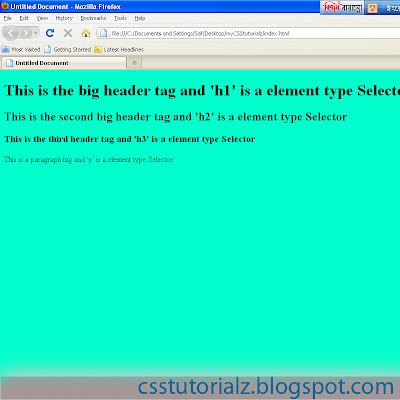
You can see four lines and each lines font size is different. You don't define the font size but how these size become different? Ok, you don't define font size but you put those four lines in four different HTML tags and they are h1, h2, h3 and p. I said that by default each tags have its own attribute such as font size, color etc. And that's why you see the different lines. So, now is the time for you to create you own ELEMENT TYPE CSS code in your style.css page. Open you style.css page. Add the following code under the body codes like this:

You just need to write the h1 tags code just like the last picture. You wrote the body code before if you have see the csstutorialz from beginning or from the 1st csstutorialz. Now, save your style.css page, go to your HTML page, save it and preview it.

With the same process change the attibutes of h2, h2 or the p tags. So, add the following codes into your style.css file (not in ur HTML file):

Code Analysis: look at the h2 attribute codes. color #FF0000 sets RED color for h2 tag. If you are not familiar with color code please search color codes on Google and get the color codes of various colors. the font-size sets to 36 pixel and here font-weight is bold, that means the text of inside the h2 tag become bold.
Inside the 'p' attribute codes the code background sets a WHITE background for paragraph or 'p' tag. You can set background individually to any element type selector. So, you can sets background for h1 or h2 tags as your wish. I think rest of the codes u have understand. So now, save your style.css page, save your HTML page and preview your HTML page.

You can see your page or your attributes of different tags have been changed. the h2 tags text looks bigger and RED, your have got a white background in your paragraph tag. Before finishing this tutorial I want to show you a great tips that how can you optimize your Style codes if you have the same attribute on different element type selector. You can combine different element type selector which have the same attribute separate with comma like this:

Here all of the three header tags have the same color of WHITE and have different font size. This is called Grouping. This is the preview:

Thanks for being with me. In the next tutorial I will introduce you to the rest of the two types of CSS Selectors (ID Selector and Class Selector.) Hope you will enjoy.
- Element Type Selector
- Class Selector
- ID selector
Element Type Selector:
Element Type Selector is usually an HTML element or a tag. You can see wikipedia for more details but I think you don't need the theory at all! Look at the following figure:


Look at inside the body tags. If you are familiar with HTML tag you can easily understand what I want to point out. Inside the body tag you can see h1, h2, h3 and the p tags. Each tag has its own attribute by default. If you are novice in HTML you may not understand the whole think. Ok, lets preview this page.

You can see four lines and each lines font size is different. You don't define the font size but how these size become different? Ok, you don't define font size but you put those four lines in four different HTML tags and they are h1, h2, h3 and p. I said that by default each tags have its own attribute such as font size, color etc. And that's why you see the different lines. So, now is the time for you to create you own ELEMENT TYPE CSS code in your style.css page. Open you style.css page. Add the following code under the body codes like this:

You just need to write the h1 tags code just like the last picture. You wrote the body code before if you have see the csstutorialz from beginning or from the 1st csstutorialz. Now, save your style.css page, go to your HTML page, save it and preview it.

With the same process change the attibutes of h2, h2 or the p tags. So, add the following codes into your style.css file (not in ur HTML file):

Code Analysis: look at the h2 attribute codes. color #FF0000 sets RED color for h2 tag. If you are not familiar with color code please search color codes on Google and get the color codes of various colors. the font-size sets to 36 pixel and here font-weight is bold, that means the text of inside the h2 tag become bold.
Inside the 'p' attribute codes the code background sets a WHITE background for paragraph or 'p' tag. You can set background individually to any element type selector. So, you can sets background for h1 or h2 tags as your wish. I think rest of the codes u have understand. So now, save your style.css page, save your HTML page and preview your HTML page.

You can see your page or your attributes of different tags have been changed. the h2 tags text looks bigger and RED, your have got a white background in your paragraph tag. Before finishing this tutorial I want to show you a great tips that how can you optimize your Style codes if you have the same attribute on different element type selector. You can combine different element type selector which have the same attribute separate with comma like this:

Here all of the three header tags have the same color of WHITE and have different font size. This is called Grouping. This is the preview:

Thanks for being with me. In the next tutorial I will introduce you to the rest of the two types of CSS Selectors (ID Selector and Class Selector.) Hope you will enjoy.
Saturday, September 4, 2010
csstutorialz-4: Creating Your First Style Sheet (External)
There have three types of CSS or Cascading Style Sheets. They are:
Step 1: Open Dreamweaver (CS5 or CS4 or CS3 or any version). You will see the following scenario.

Step 2: Then create an HTML file from file menu (click new and choose HTML)and save it in a folder. Suppose we create an HTML file and name it index.html and save it in a folder called myFirstCsstutorialz. The following is the preview of index.html page. When we create a HTML file we will see by default the design view of this page.


Step 3: Create Your first style sheet. From the file menu click new and then choose CSS. You must create a blank CSS page and save it to the same folder (Where you save ur HTML file or index.html file). I have created a CSS named style.css and save it to myFirstCsstutorialz folder. The CSS page looks like as follows:

Step 4: So, now the time for writing your first CSS code. In the style.css page write down the following code like this:

body is for the body tag of HTML page
the second bracket “{” is the starting and “}” it the
ending period of body tag
‘background’ sets a background color for body
here the color is light green and code is #00FFCC.
Step 5: Now, if you preview your HTML page will you get an Light Greed page? The answer is 'no'. Because you didn't link up ur style.css to the HTML page. How can you link up these?
Click your HTML page and change the design mode to code mode, that means click 'code' for the code view of HTML file. you will see the following scenario:

You might can see the head tag. inside this head tag write down the following code:

look at the red box. 'href' means hyperlink reference and 'style.css' is the name of your style sheet. your style sheets name can be any like 'xyz.css' or others. rest of the others code you must write. Your page looks like this:

Look at the red box. You just included this line of codes.
Step 6: So, now the final step. You have created a HTML file, you have created a CSS file and you link up them. Thats complete your task. Just save your HTML and CSS file (ctrl+s) and preview the HTML file. [Note: if you don't save your HTML/CSS file you will not see any changes on your preview page.] Your page look like this:
 You will see the greed page, not the congratulation message. The congratulation message is from me. Thanks for with my csstutorialz-4. In the next tutorialz i will tell you about different types of CSS Selectors.
- In-Line Style
- Embedded Style
- External Style Sheet
Step 1: Open Dreamweaver (CS5 or CS4 or CS3 or any version). You will see the following scenario.

Figure: Dreamweaver CS3
Step 2: Then create an HTML file from file menu (click new and choose HTML)and save it in a folder. Suppose we create an HTML file and name it index.html and save it in a folder called myFirstCsstutorialz. The following is the preview of index.html page. When we create a HTML file we will see by default the design view of this page.

Figure: HTML file
You can preview this blank page and one important think is you must create a new HTML blank page. So, lets preview this blank HTML page by pressing f12 key. Can you see ur blank page? wow!! if not please be patient, I think you don't follow those steps carefully. I have seen a blank white page like this:
Figure: Preview HTML page
Step 3: Create Your first style sheet. From the file menu click new and then choose CSS. You must create a blank CSS page and save it to the same folder (Where you save ur HTML file or index.html file). I have created a CSS named style.css and save it to myFirstCsstutorialz folder. The CSS page looks like as follows:

Figure: CSS page
If can see some codes/words are written there, you can delete them. Because sometimes if you don't create a blank CSS page then there might have some code there. We don't need them. We will write code by ourself. So, if you see some code on the style.css page just delete them. (Note: You will not delete any code from the HTML file that you have created before.)Step 4: So, now the time for writing your first CSS code. In the style.css page write down the following code like this:

Figure: write your first css style code
Code Analysis: The code analysis is not the part of your code. I just analyze the code for you. Code analysis:body is for the body tag of HTML page
the second bracket “{” is the starting and “}” it the
ending period of body tag
‘background’ sets a background color for body
here the color is light green and code is #00FFCC.
Step 5: Now, if you preview your HTML page will you get an Light Greed page? The answer is 'no'. Because you didn't link up ur style.css to the HTML page. How can you link up these?
Click your HTML page and change the design mode to code mode, that means click 'code' for the code view of HTML file. you will see the following scenario:

You might can see the head tag. inside this head tag write down the following code:

look at the red box. 'href' means hyperlink reference and 'style.css' is the name of your style sheet. your style sheets name can be any like 'xyz.css' or others. rest of the others code you must write. Your page looks like this:

Look at the red box. You just included this line of codes.
Step 6: So, now the final step. You have created a HTML file, you have created a CSS file and you link up them. Thats complete your task. Just save your HTML and CSS file (ctrl+s) and preview the HTML file. [Note: if you don't save your HTML/CSS file you will not see any changes on your preview page.] Your page look like this:

Friday, September 3, 2010
csstutorialz-3: Why CSS or Cascading Style Sheet?
You the people who are already familiar with HTML/XHTML know that we can easily create pages without Style Sheets. So, why we use it? The answer is as follows:
1. If your website has only one page then you don't need CSS and If your website has only five pages then it might be your options to choose CSS or not, but if your website has 100 pages then you must use CSS. Because you r not able to write the same styles or same codes in 100 pages. I think u r not clear that what I want to say.. OK.. lets see the following picture:
1. If you have one page then you can write the style codes and HTML codes in one page. This picture shows it..

2. But if you have 5 pages then you have two choices. You can use a style sheet or not, but if you use a style sheet then it will be best process to create a website, this reduces the codes and page loads. Look at the following figure.

There have 5 pages and also look at the red box of page1. You are writing this box style code in the other five pages, because most of cases your web pages styles are the same in five or more pages. As for example header, main menu or left side menus view are same in all the pages. So, why you write the same code in the all five or more pages?? Your HTML codes are different but your Style Sheet codes are not different. So, if you have 100 pages then will you write 100 same style sheet codes into 100 pages?? And if a change needs in the style sheet then will you change the codes in 100 pages? Is it possible? So, whats the solution? The solution is you need to use a external style sheet. I will show you in the next chapter how can you add a external style sheet but now see the solution in the following figure:

1. If your website has only one page then you don't need CSS and If your website has only five pages then it might be your options to choose CSS or not, but if your website has 100 pages then you must use CSS. Because you r not able to write the same styles or same codes in 100 pages. I think u r not clear that what I want to say.. OK.. lets see the following picture:
1. If you have one page then you can write the style codes and HTML codes in one page. This picture shows it..

Figure: One HTML page with Style Codes
2. But if you have 5 pages then you have two choices. You can use a style sheet or not, but if you use a style sheet then it will be best process to create a website, this reduces the codes and page loads. Look at the following figure.

Figure: Five different HTML page with Style codes

Figure: You have only one Style page and 5 or 100 or unlimited number of HTML pages
Thanks for reading this tutorial. The next tutorial will show you how can you write your first CSS Style and how can you link up your style sheet to the HTML page.
Subscribe to:
Posts (Atom)